
Knowledge about CMS, websites and best practices.
Tips for website editors, product updates and best practices for building modern websites with Siteor CMS.
Case study: a site on Siteor grew from 17 to 69 countries in a month
On 7 September a site built on Siteor got an email that opened with "came across your app today." It was from the owner of a small contract winery in Australia, processing around 100 tonnes a year. He found the site on his own. Not through an ad, because there wasn't a single one in that market. Not through a referral, because nobody there knows anyone in Australia. He found it because the page showed up in search and was readable.
The site is VineyardElf, software for winemakers. Full disclosure: it's a product from our own stable, which is why we had access to its raw Google Search Console data and can show it here. But it runs on Siteor exactly like any other site on the platform: the same engine, the same automatic SEO, no manual tricks on the owner's side. That's what makes it an interesting case, because it shows what the engine does on its own.
How long the site has been standing
The site picked up its first Google impressions at the end of December 2025. For the first six months it lived mostly in Polish and was seen in Polish: a few dozen impressions a month, traffic almost entirely from Poland, a handful of clicks. Nothing to write home about. A good baseline, though, for what happened next.
Impressions in Search Console, month by month:
| Month | Clicks | Impressions |
|---|---|---|
| December 2025 | 0 | 5 |
| January 2026 | 5 | 45 |
| February | 3 | 55 |
| March | 4 | 191 |
| April | 1 | 74 |
| May | 8 | 72 |
| June | 2 | 103 |
| July | 3 | 127 |
| August | 19 | 984 |
| September (to 6th) | 2 | 134 |
What happened in August
At the start of August the owner made one editorial decision: English first. Not machine-translating Polish posts, but writing content in English from scratch and treating the English version as equal to the Polish one. Universal topics that matter to a winemaker in Australia exactly as much as one in Poland: grapevine diseases, the BBCH scale, frost protection, vineyard automation.
The effect, in a single month:
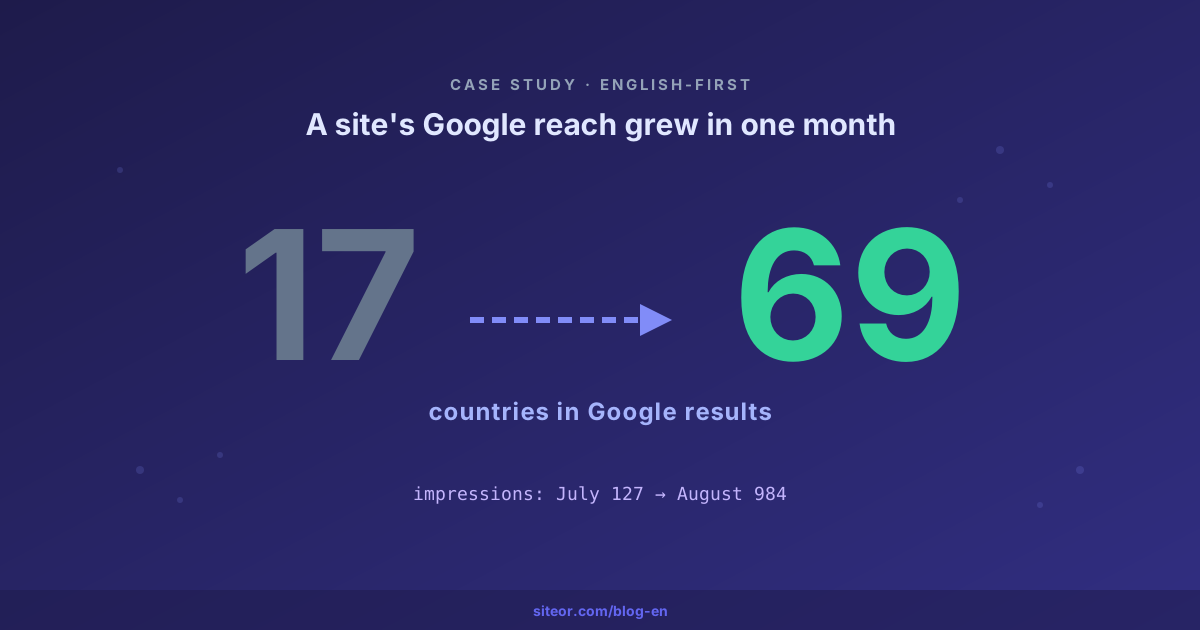
- Impressions: 127 in July, 984 in August. Almost eight times more.
- Geographic reach: 17 countries in July, 69 countries in August. A "Poland plus a few neighbours" map turned into a map of the entire English-speaking wine world.
- August impressions by country: USA 340, Poland 184, Canada 67, United Kingdom 59, Australia 40, India 23, New Zealand 21, Germany 16, Netherlands 13, Philippines 13, France 11, South Africa 10.
- Average positions in those countries: around 9 to 10, which is page one.
This is precisely the moment the site stopped being Polish and became global. Not through advertising, not through a new budget. Through changing the language of the content, and through that content being served so Google can read it without effort. The engine handles that second half.
Why Siteor can do this: the Intum CMS engine inside
The new Siteor isn't another site builder assembling a layout in the browser. Inside it runs the Intum CMS engine, the same one our own products sit on. We're moving the whole platform onto it, because it does four things a typical builder doesn't.
The content lives in HTML, not in JavaScript. When Googlebot or a language-model crawler hits the page, the source already contains the text. The heading is an h1, sections are h2, the article is an article element. The robot reads it from the first millisecond; it doesn't have to boot a framework or wait for hydration. Sites that assemble content only in the browser force the robot to guess, and robots in a hurry don't guess.
Semantics and SEO fall out of the page definition. Sitemap, canonical, hreflang, meta description, robots.txt. The engine generates all of it automatically from the list of pages, so the English version had correct canonical and hreflang from day one. That's what puts English content on the right domain without cannibalising the Polish one.
Speed as a side effect. When you're not loading megabytes of script, the page is fast on its own. The winemaker in Australia opened it on his phone, on the far side of the world, and it didn't stall. Core Web Vitals aren't an optimisation project here; they're a consequence of there being nothing to slow down.
Honest, specific content that AI wants to cite. This site's posts aren't a sales funnel. The owner writes what works and what doesn't, gives real numbers from his own vineyard, admits the limits of the models. Language models cite content like that because it's verifiable. That's the author's credit, not the engine's, but the engine stays out of his way.
Honestly, about what the numbers don't say
Because that's our style, and because without it the whole story is worthless.
Australia in August was 40 impressions and zero clicks in Search Console. The page showed up there on the first page of results for queries about autonomous vineyard machinery and the BBCH scale, but Google recorded not a single click from Australia in search. That means one thing: SEO gave visibility, not a recorded click. The winemaker from the antipodes may have reached the site through that visibility, through image search, through a citation in a language model, or by typing the address directly. We're not pretending we have proof of his click in GSC, because we don't.
The second piece of honesty: these are still small numbers. 47 clicks and 1,790 impressions over a year. English for a niche product has modest search volumes. SEO here is a channel for discoverability and AI citation, not a lead machine. We won't promise that the engine alone turns every site into a magnet for customers from the other hemisphere.
What we do promise is verifiable: if the content is good and the site is built so robots can read it without effort, one editorial decision can widen your reach from 17 countries to 69 in a month. This site did it without a cent of advertising and got an inbound from Australia. The technical half of the job is lifted off the owner by the engine: sites that Google and language models read from the first millisecond, with no plugins, no bloat, and no monthly ad invoice.
See how Siteor works and build a site Google reads immediately.